

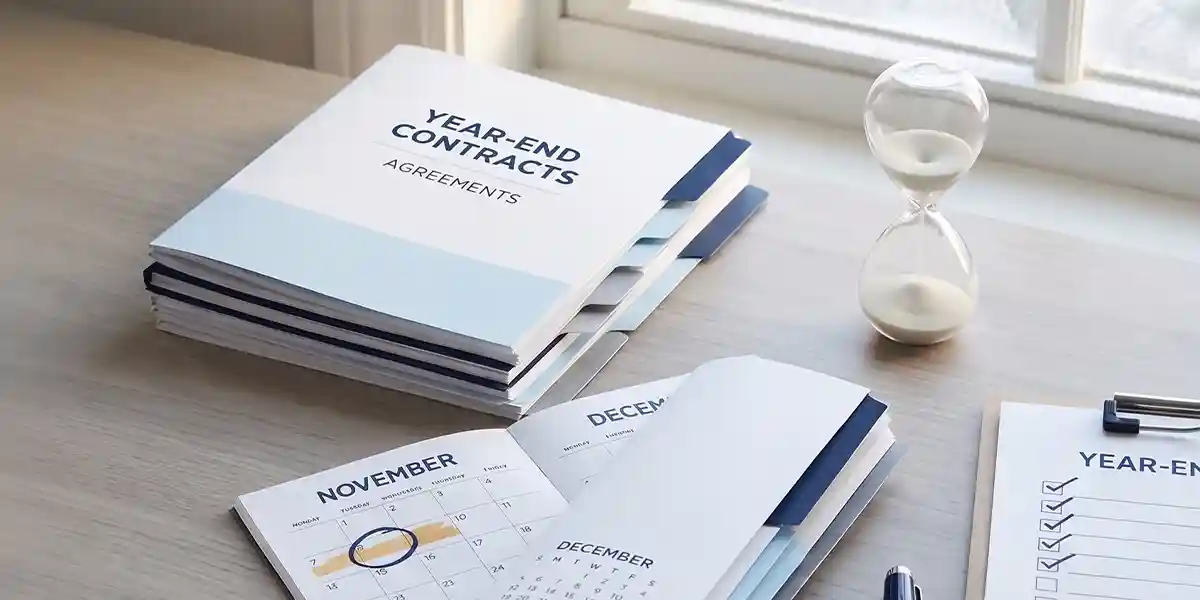
A missed contract deadline can have consequences long after the calendar turns. Consider a contract renewing on January 1 that requires 60 days’ notice to cancel; the deadline to opt out is around November 2. If you miss that window, the company risks financial exposure and could be committed to the contract for another 12 months. A year-end contract review helps you spot these risks. It helps identify upcoming notice deadlines, financial exposure, outstanding obligations, and performance issues before they become costly problems.
Use this guide to make year-end contract reviews more focused on ensuring your contracts support your business priorities and strengthen contractual relationships for years to come.
Why A Year-End Contract Review Should Start Early in Q4
The right time to review a contract isn’t determined by its renewal or expiration date. The timing of the review is determined by the contract notice deadlines, which may fall weeks or months earlier. For example, a contract renewing January 1 with a 30-day notice requirement calls for action by approximately December 2. A March 31 renewal with a 90-day notice requirement requires notice by approximately December 31.
Working backward from these deadlines gives your team time to evaluate performance, make internal decisions, negotiate changes, secure approvals, and deliver notice according to the contract’s requirements. Waiting too long to identify upcoming commitments leaves contract teams little time to act.
It’s worth noting that these dates are illustrative; actual deadlines depend on how the contract defines the notice period and specifies delivery requirements. Ideally, start a year-end contract review checklist early in Q4.
The financial stakes are worth considering. WorldCC’s 2026 research finds that weaknesses in contracting practices continue to erode nearly 10% of contract value. WorldCC’s latest research reinforces why proactive contract management matters year-round.
Fourth-quarter should be a checkpoint, not the starting point. If you need a refresher on why these reviews matter, see our guide to the value of a year-end contract review.
Before You Start: Prioritize Your Contracts
Not every contract requires the same level of review. Taking a risk-based approach will help your team focus its time appropriately. As the previous example showed, upcoming contractual notice deadlines require keen attention. Other considerations include spotting potential financial exposure and its business impact. Here is a suggested framework for each priority level:
- High Priority: Contracts with significant financial value, business-critical relationships, material risks, or upcoming renewal and notice deadlines. Conduct a full review.
- Standard Priority: Other active contracts. Conduct a targeted review of key dates, obligations, and changes.
- Close-out: Expired or inactive contracts. Confirm that outstanding and surviving obligations have been addressed.
Practical Tip: If you don’t have a reliable contract inventory, start with the last 12 months of supplier spend and customer revenue. Sort by value to identify your most financially significant relationships and determine which contracts deserve attention first.
The Eight-Point Year-End Contract Review Checklist
The following eight-point checklist provides a practical framework for reviewing your contracts based on their priority. It helps identify potential risks, protect contract value, and uncover opportunities for improvement in the coming year.
| 1: Confirm You Know What You Have | |
| What to Check | Warning Sign |
| Active contracts, amendments, SOWs, order forms, and click-through terms in one list with an owner for each. | You have vendors you paid this year with no contract on file. |
| TRY THIS FIRST:
Buy-Side: Match your accounts payable vendor list against your contract repository or shared drive to identify supplier relationships without a corresponding contract. Sell-Side: Match customer revenue records against your contract repository to identify customer relationships with missing or incomplete agreements. Both Sides: Investigate unmatched relationships and confirm that each contract record includes related amendments, statements of work (SOWs), and order forms. |
|
| 2: Map Upcoming Renewal & Notice Deadlines | |
| What to Check | Example |
| For every high-priority and standard-priority agreement, record the renewal or expiration date, the notice period, the calculated notice deadline, and the internal decision deadline. | Actual deadlines depend on how the contract defines the notice period and specifies delivery requirements. For instance, a contract expiring June 30 with a 180-day notice requirement may require a decision in December or early January. |
| TRY THIS FIRST: Add a “notice deadline” column to the spreadsheet and sort by it, not by expiration date. | |
| 3: Make a Renew, Renegotiate, or Exit Decision | |
| What to Check | Warning Sign |
| Every agreement with an upcoming notice deadline should have a documented decision and a named owner. Assess whether the agreement continues to meet business needs and commercial objectives, taking into consideration contract performance, financial value, risk, and the strategic importance of the relationship. | “Renew as is” becomes the default because no one has evaluated whether the agreement still meets the organization’s needs or commercial objectives.
Buy-Side: Are there opportunities to renegotiate terms, consolidate suppliers, competitively bid the requirements, or exit the relationship? Sell-Side: Are there opportunities to strengthen customer retention, expand the relationship, improve profitability, or renegotiate unfavorable terms? |
| TRY THIS FIRST: Create a one-line decision log for each contract: decision (renew, renegotiate, or exit), owner, decision deadline, and rationale. | |
| 4: Reconcile What You Paid (or Billed) Against What the Contract Says | |
| What to Check | Example |
| Price escalators and cost-of-living adjustments, volume tiers, rebates, credits, and payment terms. | Oversight and imbalances in service delivery. An IT Services company did not consistently apply cost-of-living adjustments (COLA). These inconsistent cost-of-living adjustments drove more than $300,000 a year in leakage that ongoing post-signature contract management support uncovered. |
| TRY THIS FIRST:
Buy-Side: Select a high-value supplier contract. Sample invoices from each quarter and compare amounts paid against contractual pricing, adjustments, discounts, and credits. Look for overcharges or missed credits. Sell-Side: Select a high-value customer contract. Sample invoices from each quarter and compare amounts billed against contractual pricing, approved increases, discounts, and credits. Look for underbilling or missed price adjustments. |
|
| 5: Compare Obligations Against What Actually Happened | |
| What to Check | Warning Sign |
| Service levels, deliverables, reporting and audit rights, on both sides of the deal. | SLA failures were logged during the year, but service credits were never claimed within the set window. Check the contractual claim window to compare what was contracted with what was performed. |
| TRY THIS FIRST: For each high-priority contract, identify the three most important obligations and mark each as met, missed, or unknown. Identify what evidence supports that assessment and assign an owner to address any gaps. | |
| 6: Close Out What Is Finished | |
| What to Check | Warning Sign |
| Expired and terminated agreements: final invoices, return or destruction of data, revoked system and building access, released guarantees.
Note the distinction between contract expiration and contract close-out. Expired contracts may have obligations related to confidentiality, warranties, indemnification, data retention, transition assistance, or outstanding payments. |
A former supplier still has an active login even after a clean contract exit. |
| TRY THIS FIRST: Send IT the list of suppliers whose contracts have expired or been terminated and ask which still have access to your systems or data. | |
| 7: Reassess Contract Risks in Light of Business Changes | |
| What to Check | Example |
| New laws or regulations, new data flows, AI use by suppliers, mergers or entity name changes, lapsed insurance certificates. | A supplier began using AI tools on your data this year, but the contract predates any AI clauses or terms. |
| TRY THIS FIRST: Ask each High Priority relationship owner one question: “What changed with this supplier or customer this year?” | |
| 8: Capture Lessons & Set Three Fixes for Next Year | |
| What to Check | Example |
| What stalled, what surprised you, what worked. | Were essential contract management KPIs (Key Performance Indicators) met, such as contract cycle time, percentage of renewals decided before the notice deadline, and obligations fulfilled? |
| TRY THIS FIRST: Identify three contract management improvements for next year, assign each an owner, a target completion date, and a measure of success. Establish a regular review cadence and schedule next year’s year-end contract review early enough to address upcoming notice deadlines. | |
Make Contract Review A Year-Round Practice
Entering a new year with a clearer picture of your organization’s contractual commitments brings clarity to your contract portfolio management. A year-end contract review helps you achieve that. Not unlike a year-end account reconciliation, a year-end review helps verify that what’s documented in your agreements matches what’s happening in practice. The review is designed to help you protect contract value and, in the process, address outstanding risks uncovered. But the benefits shouldn’t stop when the review is complete. Ongoing contract monitoring helps ensure that negotiated terms are followed and obligations get met. The process ensures teams can address potential issues before the company absorbs them as costly problems.
To help put these practices into action, download our Eight-Point Year-End Contract Review Checklist (PDF). Use it to guide your review, document findings, and assign follow-up actions across Legal, Procurement, Sales, Finance, and other key teams. Make it a starting point for a more consistent approach to contract management throughout the year.
Author: Nancy Nelson, President, ABiz Corporation, Contract Management Innovators.
Questions About Year-End Contract Reviews
What should a year-end contract review include?
A year-end contract review should confirm what contracts you have, identify upcoming notice deadlines, determine whether to renew, renegotiate, or exit, reconcile payments and billings against contract terms, assess contractual obligations, close out expired or terminated agreements, reassess risks, and identify improvements for the coming year. Prioritize upcoming notice deadlines, as missing them may limit your options.
When should you start a year-end contract review?
Ideally, start your year-end contract review early in the fourth quarter, rather than waiting until November or December. Contracts renewing on January 1 may require 30, 60, or 90 days’ advance notice, and some require even longer. Review upcoming notice deadlines throughout the year to ensure you have sufficient time to evaluate options, negotiate, and obtain approvals
How long does a year-end contract review take?
The time required depends on the size and complexity of your contract portfolio, the quality of your contract data, and the scope of the review. A focused review may take a few weeks, while larger or more complex portfolios may require considerably longer. Prioritizing contracts by value and risk and maintaining an accurate, up-to-date contract repository can significantly reduce the time required.
Do I need contract management software for a year-end contract review?
No. A well-maintained spreadsheet can support a year-end contract review by tracking key contract dates, notice deadlines, owners, obligations, decisions, and follow-up actions. Contract management software can make tracking, alerts, and reporting more efficient, particularly for larger portfolios, but the effectiveness of the review depends on accurate information, clear ownership, and consistent follow-through.
What is a common year-end contract mistake?
One common mistake is tracking contract expiration or renewal dates without tracking the associated notice deadlines. This can result in agreements automatically renewing before the organization has evaluated its options. Tracking both contractual notice deadlines and internal decision deadlines helps ensure renewal decisions are made proactively.
Who should be involved in a year-end contract review?
A contract management, procurement, or commercial lead should coordinate the review, with input from finance for payment and billing reconciliation, business relationship owners for performance and obligations, legal for contractual risks, and IT and information security for system access and data-related requirements. Each high-priority contract should have a designated owner responsible for coordinating the review, obtaining the necessary approvals, and ensuring decisions are implemented.